
Banks have spent a decade rebuilding how money moves. Instant rails, richer messaging, ISO 20022. The RTP network alone went from $246 billion in payment value in 2024 to $1.45 trillion in 2025, and passed that full-year total in the first nine months of 2026 (The Clearing House). Settlement is no longer the constraint.
Take a project finance drawdown. Before a dollar moves, the bank may need engineer certification, covenant validation, supporting evidence, and lender approval. The payment can settle in seconds. Determining whether it should happen, and proving why, can still require people to read contracts, find documents, check systems, and carry approvals by hand.
That is the context problem. Payment rails decide how fast money can move. Commercial obligations determine when it should move, how much should move, what conditions must be satisfied, and what evidence and approvals are required. Those obligations often sit apart from the payment in agreements, PDFs, mailboxes, spreadsheets, and servicing systems.
Project finance is the sharpest example, but the pattern is everywhere. An escrow release waits on a signed closing statement. A marketplace payout waits on proof of delivery. A receivable arrives on one rail and has to be matched to an obligation recorded somewhere else. The rail is rarely the bottleneck; the context is.
In conversations with transaction banking teams, the same point keeps coming up: the hardest part of a high-value payment is rarely the payment itself. It is everything the agreement says must happen first.
Every payment is the final step of a commercial obligation.
Most institutions already own systems for pieces of this. Contract lifecycle platforms hold the agreement. Origination and servicing platforms hold the schedule. Core banking executes the transaction. Each does its job, but they rarely operate around a shared understanding of the obligation. The result is fragmentation across the lifecycle, with operations teams acting as the human glue between systems.
Today, money settles in seconds, but the agreement, evidence and approvals that decide each payment sit in separate systems and are carried across by hand.
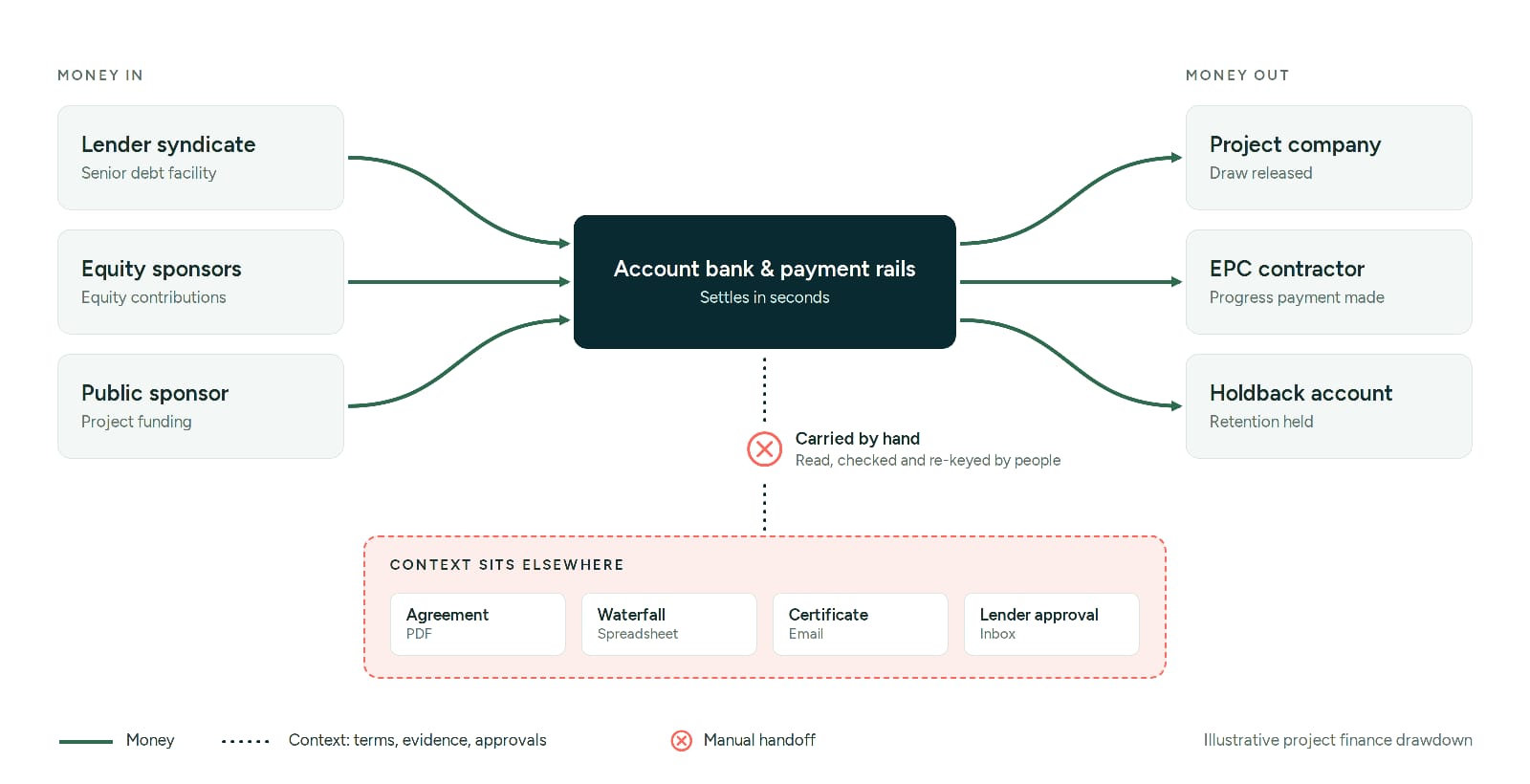
What it costs to carry context manually
The cost is not just delay. Every manual handoff is a point where interpretation can differ, evidence can go missing, and an audit trail can break.
Reserve accounts, debt service reserves, trust and retention accounts, and milestone structures all depend on contractual rules being applied exactly. When the rules sit apart from execution, institutions inherit reconciliation backlogs, disputed releases, and limited visibility into covenant breaches or funding shortfalls, usually discovered after the money has already moved.
From agreements to actionable obligations
AI can interpret contract and obligation data, identify the parties, conditions, evidence, approvals, accounts, thresholds, and exceptions involved, and connect those obligations to the documents and transaction data needed to act on them. It can gather evidence, validate conditions, identify what is missing, and maintain a current view of what has been satisfied, what remains outstanding, and what the agreement requires next.
That is when money and context move together: one lifecycle from contract to payment, with the commercial record intact at every step rather than reconstructed afterwards. More importantly, AI can reason over that context. Instead of merely showing an operator the relevant agreement, balance, document, and approval, the system can determine the next permissible action and the evidence required to support it.
From automation to agents
Traditional automation works well when the steps are fixed and rules -based. Commercial finance is rarely that clean. Documents arrive in different formats, conditions have dependencies, information goes missing, exceptions occur, and different parties have different responsibilities. Agentic AI capabilities allow the system to work through that dynamic state: initiating workflows, requesting information from or communicating with the relevant parties, routing approvals, handling exceptions, and recommending or initiating the payment when the required conditions and controls are satisfied.
Return to the project finance drawdown. An AI agent can interpret the obligation, recognize that an engineer certificate has arrived, validate it against the relevant milestone, gather the supporting evidence, check the remaining conditions, identify a missing approval, communicate with the appropriate party, and initiate the next workflow. Once all required conditions are satisfied, it can recommend or initiate the payment within the bank’s defined controls. After settlement, it can reconcile the transaction back to the obligation and preserve the evidence for the audit trail. The intelligence does not just sit beside the payment process; it understands and orchestrates the commercial process that causes the payment.
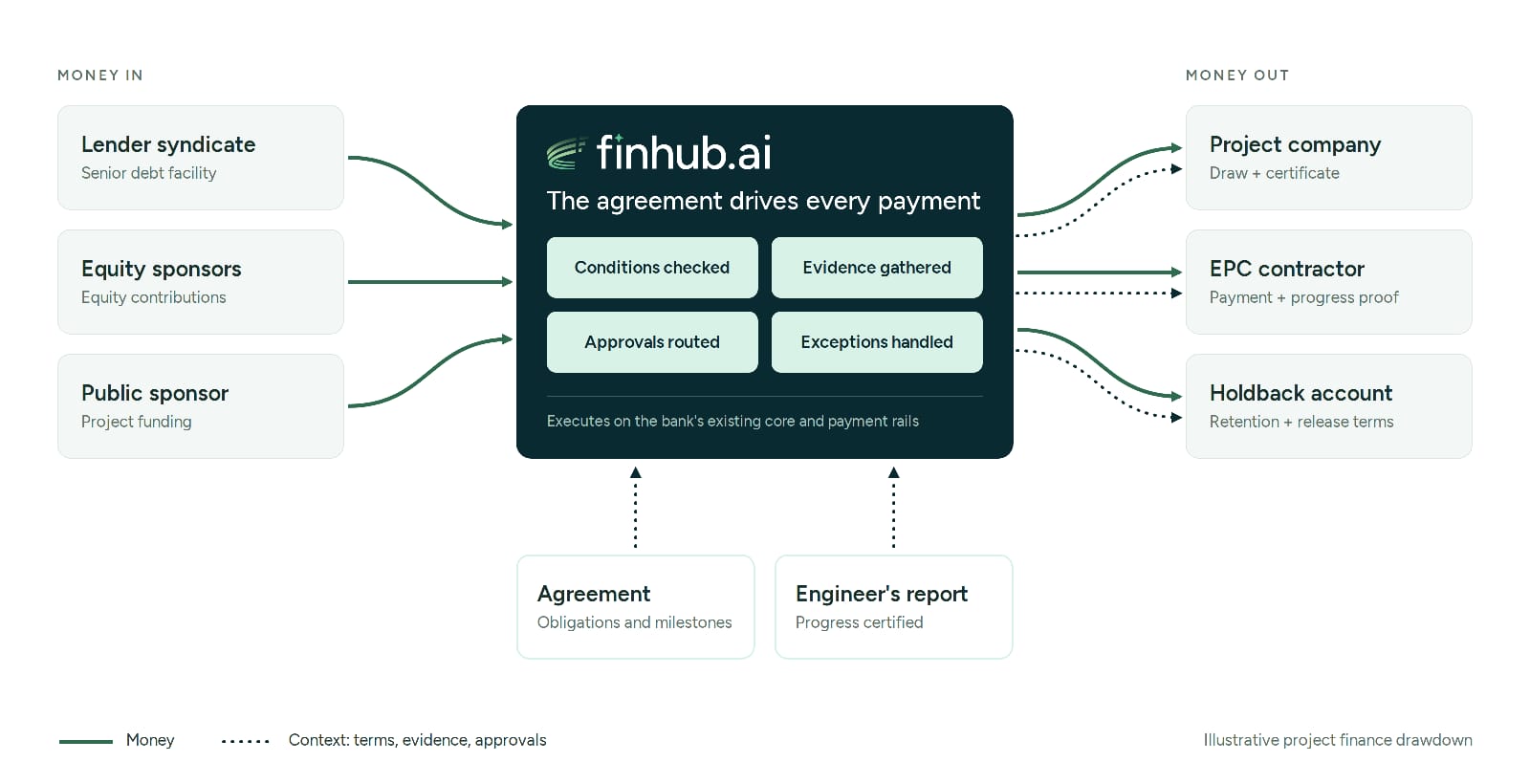
Why this matters now
For transaction banking leaders, the prize is larger than a faster back office. It is the ability to support more sophisticated products such as milestone-based payments, trust and escrow, project finance, multi-party settlement and other obligation-driven structures — without increasing operational complexity at the same rate.
None of this requires replacing the core. It requires closing the gap between the agreement and the ledger with an intelligence layer that can understand obligations, an agentic layer that can act within defined controls, and a system that maintains context before, during, and after payment.
Five questions to ask of your own business
Before evaluating any technology, transaction banking leaders can test where context breaks in their own operations:
- How many systems does a single payment decision touch on your escrow, trust and milestone-based books?
- If an auditor asked why a specific release was made, would you answer in minutes or days?
- Do you learn about a covenant breach or funding shortfall before the money moves, or after?
- How long does it take to onboard a new corporate client’s instruction formats: hours, weeks or months?
- Can you add a new rail or a new product without adding operations headcount at the same rate?
If the honest answer to most of these is “it depends who you ask”, the constraint is not the rail.
Payment modernization solved much of the problem of moving money. The next advantage will come from understanding why it should move, what must happen before it does, and what should happen next. The banks that close that gap first will set the standard for transaction banking.